
How to Style an Oversized Hoodie Without Looking Baggy

The difference between an oversized hoodie that looks expensive and one that looks like you gave up is about six inches of intention. Same hoodie, same mirror, same morning — the outfit that works is the one where something, somewhere, was clearly decided.
That is the whole secret, and everything below is just it applied seven different ways. An oversized hoodie is not a shapeless garment. It is a volume garment: it adds width up top and asks the rest of the outfit to answer. When nothing answers — baggy bottoms, hidden waist, soft shoes, no layer — the eye reads accident. When one or two things answer clearly, the same volume reads as a choice. So the question is never “is this hoodie too big?” It is “what did I decide with the rest of it?” This guide to how to style oversized hoodie outfits answers exactly that.
Oversized vs too big: the ten-second test
Before any styling, check the garment itself, because no outfit formula rescues a hoodie that was never meant to be oversized. Stand in front of a mirror and look at three points:
- The shoulder seam. On a designed oversized cut, the seam sits two to three inches past your natural shoulder — a deliberate drop. If it has slid halfway down your bicep, that is not oversized, that is the wrong size.
- The sleeve. It should end at or just past your wrist bone. Past the knuckles, you are fighting the cuffs all day, and the outfit reads borrowed.
- The hem. It should end around your hip bone or just below the waistband of your trousers. If it covers your pockets completely, the bottom half of your outfit has disappeared — and with it, any proportion you had.
Pass those three and the hoodie is a styling problem, which is a good problem. Fail them and no amount of layering will fix it — size down, or accept that this one lives at home.
The rule underneath every good oversized outfit
Here is the framework this whole guide runs on. Call it the 3-Point Balance Check: a good oversized outfit anchors the volume at three places — waist, wrist, ankle. You do not need all three. You need at least two.
- Waist: something shows where your body actually ends — a front tuck, a visible waistband, a jacket that closes, a belt line.
- Wrist: a cuff, a pushed sleeve, a watch — some evidence that the arm inside the sleeve has an end.
- Ankle: a clean shoe line, a tapered hem, a sock that means it — proof that the leg line continues below the volume.
Two anchors and the outfit reads intentional. One anchor and it reads like you tried. Zero and it reads like laundry day. Test it against any outfit photo you admire and you will see it working, usually without the wearer knowing they did it. That is the first original rule worth saving: volume needs a decision, and the decision has to be visible somewhere below the chest.
The second thing worth knowing is why fitted bottoms work — and why the advice “just wear slim jeans” is only half true. It is not about tightness. It is about contrast of language: the hoodie speaks in soft, wide, unstructured shapes, so the bottoms need to speak in something else — a straight line, a hard texture, a clean taper. Slim jeans do that. So do tailored trousers, a leather-look tapered pant, or a structured cargo with a clean cuff. What fails is not looseness itself — wide-leg trousers can work — but looseness with the same soft language as the hoodie. Two soft, wide shapes stacked together have no edge for the eye to hold. One soft shape and one sharp shape do.
How to Style Oversized Hoodie: 7 Outfit Formulas That Work
Each formula below names the contrast doing the work. Steal the contrast, not the exact items.
1. Slim denim + chunky sneakers
The default that never fails, because it does all three balance points at once: the denim tapers the leg (waist and ankle anchors), the chunky sneaker grounds the bottom line, and the hoodie’s volume gets a straight frame to sit in. Dark indigo or black denim, no distressing — the cleaner the jean, the sharper the contrast. This is the formula to reach for when you are in doubt about anything else.
2. Tapered joggers — the matching-set trap, done right
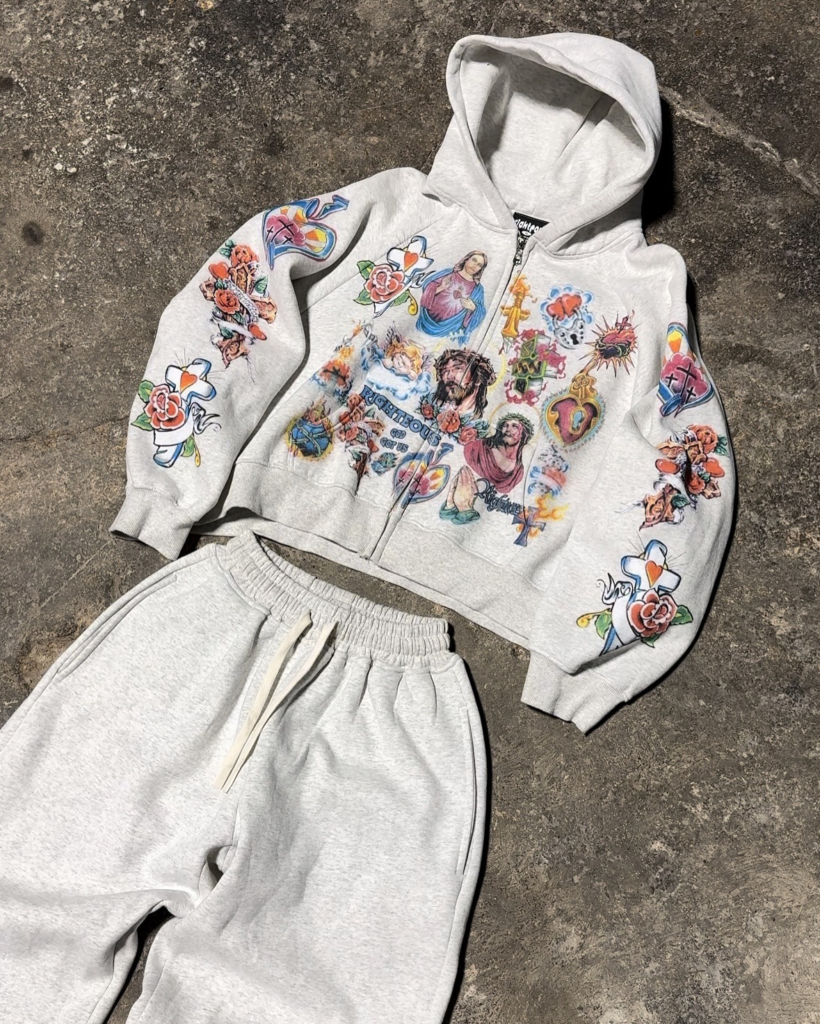
An oversized hoodie with matching sweatpants is the easiest outfit in streetwear and the easiest to get wrong, because baggy-on-baggy is exactly what the balance check warns about. The fix is in the taper: joggers that narrow hard at the ankle, a visible cuff, and a shoe with some weight to it. The set then reads as a uniform, not a blanket. If your sweatpants pool at the ankle, cuff them or change them — the ankle anchor is doing all the work here.
3. The long coat over the top
A camel or charcoal overcoat worn open over an oversized hoodie is the fastest way to make the outfit look considered. The coat’s structured shoulders frame the hoodie’s softness, its long vertical line restores the leg line the hoodie hides, and the formality gap — tailored coat, fleece hoodie — is itself the statement. Keep the coat slightly fitted through the arms; a coat that strains over the hoodie just adds a second volume problem. Our oversized hoodies are cut exactly for this — heavyweight enough to hold their shape under a coat instead of collapsing into it.
4. The front tuck
Tuck just the front four to six inches of the hoodie into high-waisted bottoms and leave the rest loose. It creates a clean horizontal break at the waist, shows the waistband, and shortens the visual length of the hoodie without committing to a full tuck — which would fight the whole point of the silhouette. It works best with wide-leg or straight trousers, where the tuck is the single sharp decision in an otherwise relaxed outfit.
5. Open zip-up as a layer, not a top
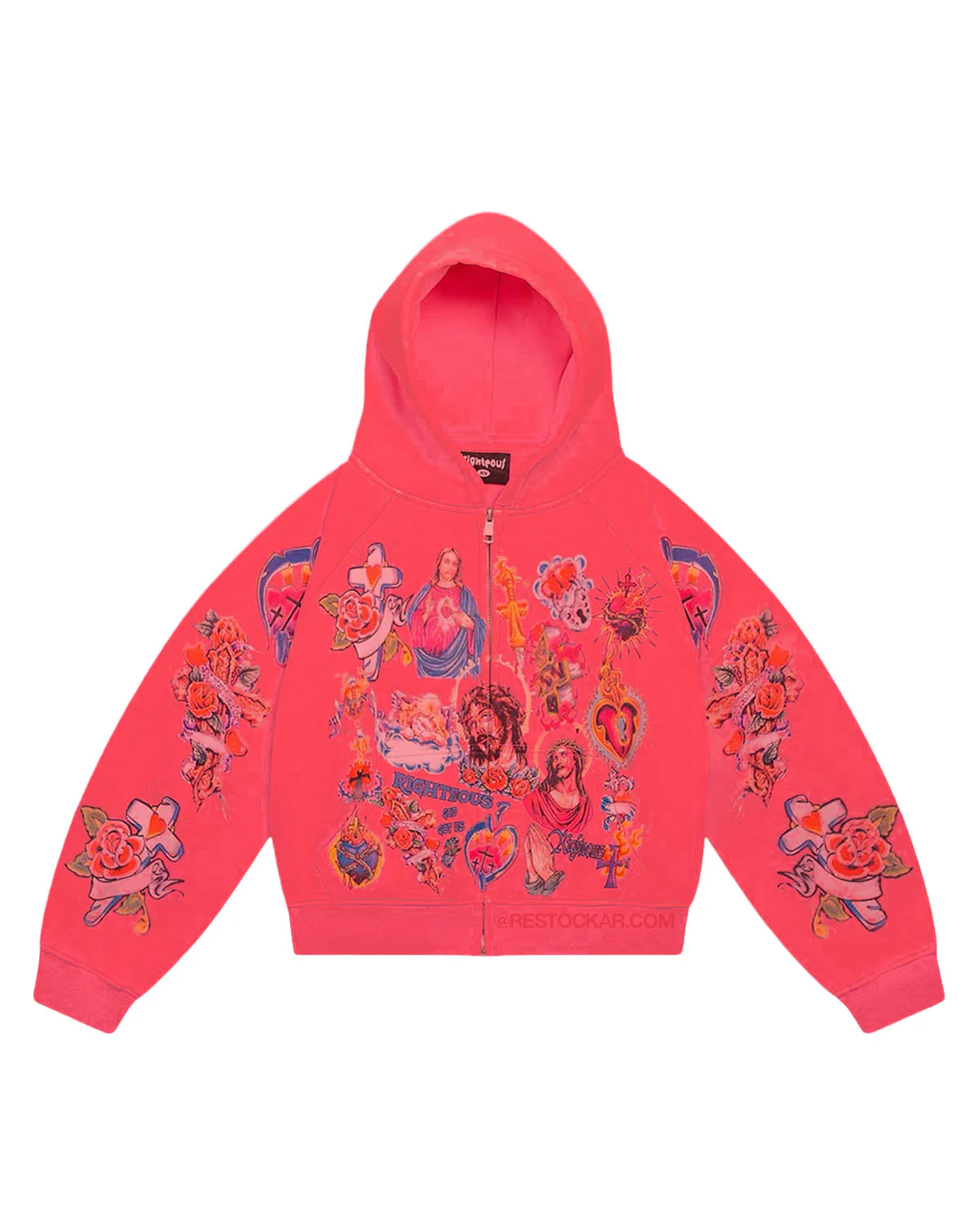
Wear the zip-up open over a fitted tee — the tee becomes the vertical line, the open hoodie becomes the frame. This is the formula that makes a loud graphic wearable on an ordinary day: the artwork splits across two panels and reads as a jacket, not a billboard, and the fitted layer underneath supplies the waist and wrist anchors the open front cannot. Keep the tee plain and the bottoms tapered; the hoodie is already doing enough talking. A white base layer under a dark zip-up is the cleanest version — see how it sits on our Risen King zip-up in white, where the print runs edge to edge and the open front turns it into outerwear.
6. Shorts + high socks (warm weather)
Oversized hoodie, shorts, crew socks pulled up, sneakers. It sounds like a dare and it works, because the bare leg is the strongest possible contrast to the volume up top — the ankle anchor doing overtime. The rule is proportion: the hoodie should hit mid-thigh at most, so there is real leg on show. Longer than that and the outfit tips back into shapeless. Keep the socks plain and the sneakers clean; this formula has exactly one joke in it and it is the hoodie itself.
7. Monochrome with texture contrast
All black, all grey, all cream — one colour, three textures. Fleece hoodie, denim or leather-look bottom, a different-fabric shoe. Monochrome outfits fail when everything is the same soft material; they succeed when the eye can tell the pieces apart by touch even though the colour never changes. This is the quietest formula here and the one that photographs best, because the camera reads texture before it reads fit. It is also the most forgiving if your hoodie is genuinely heavy — weight reads as quality in a single colour, and as bulk in a busy one.
The mistakes that make it look baggy
- Baggy on baggy with no anchor. Wide hoodie, wide pants, soft shoes, nothing fitted anywhere. The 3-point check returns zero. Fix one point — taper the pants, show the waist, ground the shoes — and the same two garments work.
- Hiding the waist completely. A hoodie that covers the waistband, the pockets and the first inches of thigh removes every cue about where the body ends. A front tuck or a jacket that closes solves it in seconds.
- Shoes that disappear. Thin sandals, flimsy slip-ons or mid-calf boots under an oversized hoodie fracture the leg line. The shoe needs enough presence to balance the volume above it — a chunky sneaker, a boot with a real sole.
- The wrong layer order. A fitted jacket under an oversized hoodie just bunches; a structured layer goes over. And a second oversized layer on top of the first is volume squared — one oversized piece per outfit is the rule, everything else earns its place by being fitted or structured.
- Treating the hood as an afterthought. A hood bunched at the neck, half-zipped and rumpled, signals disarray even when everything else is precise. Smooth it flat or wear it up deliberately — a hood worn with intent frames the face; a hood left to chance frames the mess.
Fit details that matter more than the brand
Heavyweight fabric is your ally here — that is why our heavyweight hoodies are cut the way they are — and this is the one place fabric weight genuinely changes the outcome: a heavier fleece holds its own shape instead of collapsing against the body, so the drape looks architectural rather than deflated. Thin, flimsy knits cling where they should fall and pool where they should hold — that is why a cheap oversized hoodie so often looks worse than a heavy one in the same size. (For the full picture on fabric weight, what GSM actually measures and where it stops mattering, read our hoodie fabric and fit guide — and when our GSM explainer lands, it will link from there.)
Ribbed cuffs and a ribbed hem are also doing quiet work: they stop excess fabric pooling at the wrist and waist, which is where “oversized” slides into “unfinished”. If your hoodie has neither, a sleeve pushed to just below the elbow does the same job by hand — exposing the forearm resets the scale of the whole outfit and, as a side effect, makes the torso look longer.
Our take: why we cut ours boxy
We make our hoodies the way we do on purpose. Our signature cut is boxy and heavyweight, with the artwork running across the whole garment — body and sleeves — instead of sitting as a small chest print. That is a deliberate choice, and it changes how the piece wants to be worn: a boxy, all-over-print hoodie is not a layer to hide under something else, it is the statement the rest of the outfit answers. Tapered bottoms, a clean shoe, one visible decision at the waist or the wrist — that is all it asks for. The formulas above were written against our own pieces first, because if a styling rule does not survive contact with a heavyweight, edge-to-edge graphic zip-up, it is not a rule, it is a wish.
If you are building around one piece, start with the Righteous hoodies collection and pick the colourway that already lives in your wardrobe — black and white do the most work across the seven formulas above, and the bolder colourways earn their keep in formulas 5 and 7, where the rest of the outfit stays quiet. And if you are still deciding what the brand itself is about before you buy anything, start with what We Are Righteous actually makes — the styling only makes sense once you know why the artwork is there in the first place.
FAQ
Should an oversized hoodie cover my pockets?
Ideally not. If the hem hides your trouser pockets completely, the bottom half of your outfit has vanished and the proportions go with it. Around the hip bone is the sweet spot; a front tuck fixes a hem that runs long.
Can I wear an oversized hoodie with wide-leg trousers?
Yes — if something else in the outfit is sharp. A front tuck at the waist, a structured coat over the top, or a clean shoe line can carry the balance. What fails is wide-on-wide with nothing fitted anywhere.
How do I stop the sleeves looking too long?
Push them to just below the elbow. It exposes the forearm, resets the scale of the outfit, and reads as deliberate rather than borrowed. If the cuff still covers your hand after that, the sleeve is genuinely too long for you.
Read next
- What Is We Are Righteous Clothing? The Complete Guide — the brand, the pieces, and why the artwork looks the way it does.
- The Righteousness Hoodie Guide: Styles, Fit, Fabric and What to Check Before You Buy — fabric weight, fit checks, and what to look for before you buy any heavyweight hoodie.
Next in this series: our sizing guide — which size to order when the cut is already boxy — lands as soon as it is published; this article will link to it then.