Do Righteous Hoodies Run Big? The Oversized Sizing Guide (Size Up, Down, or True)

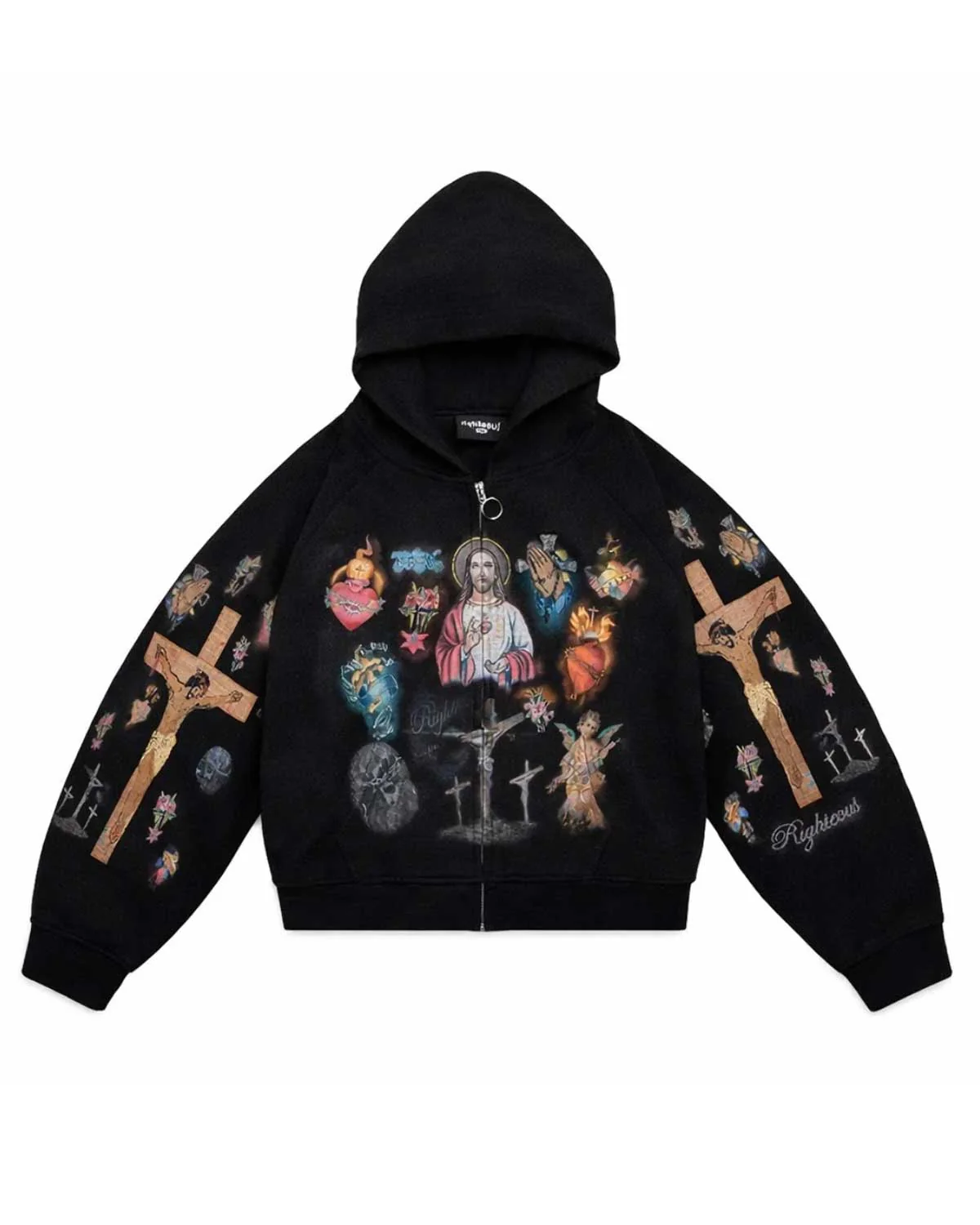
Short answer first: yes, our hoodies run big — on purpose. And that is exactly why you should not size up. The oversize is already built into the pattern, so if you go up a size on top of it, you are not getting a better fit. You are wearing two oversized decisions at once. Take your usual size for the fit you see in our photos, go one down for a closer fit, and go one up only when you want maximum room. That is the whole guide in three sentences — the rest of this page is the proof, the numbers, and the exceptions.
This is righteous hoodie sizing without the guesswork: the real garment measurements for our zip-ups and sweatpants, what “oversized” actually means in inches, how the fit changes between our builds, and the 60-second check that gets your size right the first time.
Why “run big” is the wrong question
Every sizing question starts from the same confusion, and it is not your fault. Size letters pretend to be a universal language, and they are not. A medium in one brand can sit two or three inches wider in the chest than a medium in another, and both labels are telling the truth — because a size letter never described your body. It describes a garment, cut to a pattern, with a certain amount of extra room built in. That extra room is called ease, and it is the whole story of our fit.
Our hoodies are cut with a lot of ease on purpose: wide through the body, dropped at the shoulder, longer in the sleeve than a regular hoodie. The drape you see in our photos is not an accident of photography and it is not a sizing mistake. It is the design. So when someone asks “do Righteous hoodies run big?”, the honest answer is that they are not running big relative to their own pattern — they are exactly the size the pattern says. They only look big if you judge them against a regular-fit hoodie, which is like judging a wide-leg trouser against a skinny jean and calling it a mistake.
Here is the insight most sizing guides never say out loud, and it is the one that saves you from the classic error: do not size up twice. The oversize is already in the cut. If you buy your usual size, you get the oversized look. If you size up as well, you get an oversized cut in a bigger size — shoulders near your elbows, a hem past your hips, sleeves over your knuckles — and then you write a review saying the brand runs huge. It does not. You doubled the decision. The rule for any genuinely oversized piece, ours or anyone’s, is the same: start with your normal size, and only move up if you want an exaggerated version of a look you already have.
Righteous hoodie sizing: the numbers
Forget the size letter for a minute and look at the garment. Our zip-up chart is published by our US stockist Soles District on the Risen King Zip Up and Tatted Believer pages, and it is the chart our full size guide reproduces. Two measurements matter. A is the body length, from the high point of the shoulder to the hem. B is the width straight across the chest, laid flat — double it for the full chest circumference. Read it and the cut explains itself:
| Size | A — Length (in) | B — Width, flat (in) | Full chest (in) |
|---|---|---|---|
| XS | 21.25 | 27.6 | 55.2 |
| S | 22 | 28.33 | 56.7 |
| M | 23.25 | 29.1 | 58.2 |
| L | 24.4 | 30.33 | 60.7 |
| XL | 25.6 | 31.5 | 63 |
| XXL | 26.8 | 32.33 | 64.7 |
Look at the medium: 23.25 inches long, 58.2 inches around the chest. The chest is two and a half times the length. That ratio is the entire fit in one number — a short, extremely wide body. A regular hoodie in medium is roughly 27 inches long and 44 inches around the chest, so ours is shorter and far wider at the same letter. That is why the piece looks enormous on a hanger and exactly right on a body: the width is doing the work, not the length. If you have ever held one up and thought “there is no way this is a medium”, now you know — it is a medium, cut wide on purpose.
The practical way to use this chart is not to measure your body against it. Body measurements and garment measurements are different things, and mixing them up is the single most common sizing mistake in streetwear. Instead, lay a hoodie you already own and love flat on a bed, measure it the same way — length, then width across the chest — and compare garment to garment. If your favourite hoodie measures 29 inches across the chest and ours measures 29.1 in medium, you already know how a medium will sit on you. No guessing, no size-letter roulette.
The three fits: true size, one down, one up
Once the numbers are clear, the decision is simple. There are only three fits, and each one is a real choice, not a right and a wrong answer. Save this — it is the whole guide in a pocket:
- Your usual size — the photo fit. This is the intended drape: the dropped shoulder, the wide body, the cropped length sitting where it is meant to sit. If you like what you see in our photos, this is your size. The Risen King Zip Up in White in your normal size is the reference point for the whole range — the standard build, the standard fit.
- One size down — the closer fit. Same piece, same artwork, less volume. The shoulders sit nearer your natural line, the body drapes instead of billowing, and the cropped length reads more deliberate. Choose this if you want the art visible without the full streetwear volume, or if you mostly wear your hoodies under a jacket. It is still an oversized cut — one down does not turn it into a slim fit, it just turns the volume down.
- One size up — maximum room. The full statement. More drape, more length, sleeves that stack at the cuff. Choose this if you layer heavy pieces underneath, if you want the exaggerated silhouette, or if you are between sizes and prefer room over precision. Do not choose it because you are afraid the piece runs small. It does not.
Between sizes is the only genuinely hard case, and the answer depends on what you will do with the piece. Between sizes and planning to layer a tee or a thermal underneath? Take the larger one — the extra room is working for you. Between sizes and wearing it mostly on its own, or under a fitted jacket? Take the smaller one — a hoodie that is slightly close still drapes, while a hoodie that is slightly too big fights everything you put over it. And if you are between sizes and still unsure, the smaller size is the safer mistake: an oversized cut forgives a size down far better than it forgives a size up.
Not every Righteous piece fits the same
The chart above is the standard zip-up build, and most of our hoodies follow it — but not all of them, and the differences are worth knowing before you order. The thermal line is the first exception. Our Ultimate Sacrifice Thermal Zip Up is a heavier, warmer build, and heavy fabric holds a wide shape more stiffly than lighter fleece. In practice that means the thermal reads a touch boxier at the same size: if you are between sizes on a thermal, lean to the smaller one, and expect the shoulders to sit a little more structured than on the standard zip-up.
The distressed pullovers are the second. The 3:16 Distressed Hoodie is a pullover, not a zip-up, and it follows the same oversized family cut — but a pullover has no zip to open, so the fit is decided entirely by the body you choose. With a zip-up you can cheat a slightly roomy size open over a tee; with a pullover, what you buy is what you wear. Take your usual size unless you specifically want the extra drape, and remember the pre-washed, distressed finish means the piece arrives already softened — the fit you feel on day one is the fit you keep.
The cropped zip-ups are the third, and the most misunderstood. The Risen King Cropped Zip Up in Black sits at the waist by design — the short length is the point, not a size you got wrong. If you order a cropped zip-up expecting it to cover your hips, no size will fix that, because the length barely grows between sizes (about half an inch per size on the chart) while the width grows by more than an inch. Going up a size on a cropped piece mostly makes it wider, not longer. So for cropped, choose by width, and pair it with high-rise bottoms — the proportion only works when the waistband meets the hem.
The quieter family follows the same chart too. Our Tatted Believer Zip Up in Cream runs on the identical zip-up measurements as the Risen King — same length, same width, same rule. That consistency is deliberate: once you know your size in one of our zip-ups, you know it in all of them, and you can carry it across the range without re-learning the fit for every new drop.
And the bottoms? Sweatpants, briefly
A sizing guide that only covers the top half is only half a guide, so here is the short version for the bottoms. Our sweatpants run on the official chart published with the Risen King Sweatpants — waist measured flat across the top of the garment (elastic and drawstring, so this is the garment, not your body), full outside length, and leg opening. A medium, for reference, is 26.75 inches across the waist flat, 40.2 inches long, with an 11.4-inch leg opening; the range runs XS to XXL, waist 25.2 to 29.1 flat. The rule is the same as the hoodies: your usual size gives the intended relaxed fit, and the elastic waist forgives a lot — if you are between sizes, the larger one is the comfortable mistake here, because a drawstring waist can always be pulled in and a too-tight waist cannot be let out. The Risen King Sweatpants in Black are the reference pair, and the full table — sweatpants, tees, shorts, denim — lives on our size guide page.
Tees deserve one line, because people get them wrong in the opposite direction: our tees are true to size for their intended relaxed fit — one down for fitted, one up for a full oversized drape. Do not size your tee the way you size your hoodie. The hoodie is built wide; the tee is built relaxed. Different starting points, different decisions.
Will it shrink? The care question behind every sizing question
Almost every “does it run big” search has a second question hiding behind it: “will it still fit after I wash it?” Cotton-heavy fleece can give up a small percentage of its size in the first few washes, especially on high heat, and that is true of our pieces like any other heavyweight cotton. Two habits keep the fit you bought: wash cold, inside out, and air dry when you can. A dryer will not destroy a print in one cycle, but it hurries both fading and shrinkage along, and the size you lose to heat is the size you cannot get back. The distressed and acid-washed pieces arrive already softened, so what you feel on day one is close to what you will keep — but the care label on your specific garment is still the final word, and it outranks anything in this guide.
The 60-second size check
Before you order any Righteous hoodie, run this. It takes a minute, and it replaces every sizing argument on the internet:
- Pick your fit first. Photo fit, closer fit, or maximum room? Decide the look before you decide the letter — the letter follows the look, not the other way round.
- Measure a hoodie you love. Lay it flat, measure length and width across the chest, and find the closest row on our chart. That row is your size.
- Check the build. Standard zip-up, thermal, distressed pullover, or cropped? Thermal reads boxier, pullovers cannot be opened to cheat the fit, cropped grows wider — not longer — as you size up.
- Between sizes? Layering underneath or wearing it solo? Layering takes the larger size; solo takes the smaller one.
- Match the bottoms. If the hoodie is cropped, the bottoms need a high rise — the hem has to meet a waistband, not a belt line.
That is the whole method. No size-letter superstition, no hoping the reviews agree, no ordering two sizes and returning one. Measure the garment, pick the fit, check the build.
FAQ
Do Righteous hoodies run big?
Yes, by design. Our zip-ups are cut oversized — wide through the body with a dropped shoulder and a cropped length. A medium measures 23.25 inches long and 58.2 inches around the chest, which is far wider and a little shorter than a regular-fit medium. Your usual size gives you the intended fit; size down for a closer fit, up for maximum room.
Should I size up or down for an oversized hoodie?
Neither, to start with — take your usual size, because the oversize is already in the cut. Size down one if you want a closer, cleaner fit, and size up one only if you want the exaggerated drape or you layer heavy pieces underneath. Sizing up an already-oversized cut is the most common fit mistake we see.
Do the cropped zip-ups run short?
They are short on purpose — the cropped length sits at the waist, and that is the design. Length grows only about half an inch per size while width grows by more than an inch, so going up a size makes a cropped piece wider, not meaningfully longer. Choose cropped by width and wear it with high-rise bottoms.
Start with the range itself — every hoodie in our current catalogue lives with our hoodies — and for the brand story behind the pieces, start with what We Are Righteous is, or what Christian streetwear means if you are new to the whole idea — and if you are choosing your first heavyweight piece, the righteousness hoodie guide covers fabric and buying checks in full. The complete charts for every family are on our size guide page.
One thought on “Do Righteous Hoodies Run Big? The Oversized Sizing Guide (Size Up, Down, or True)”