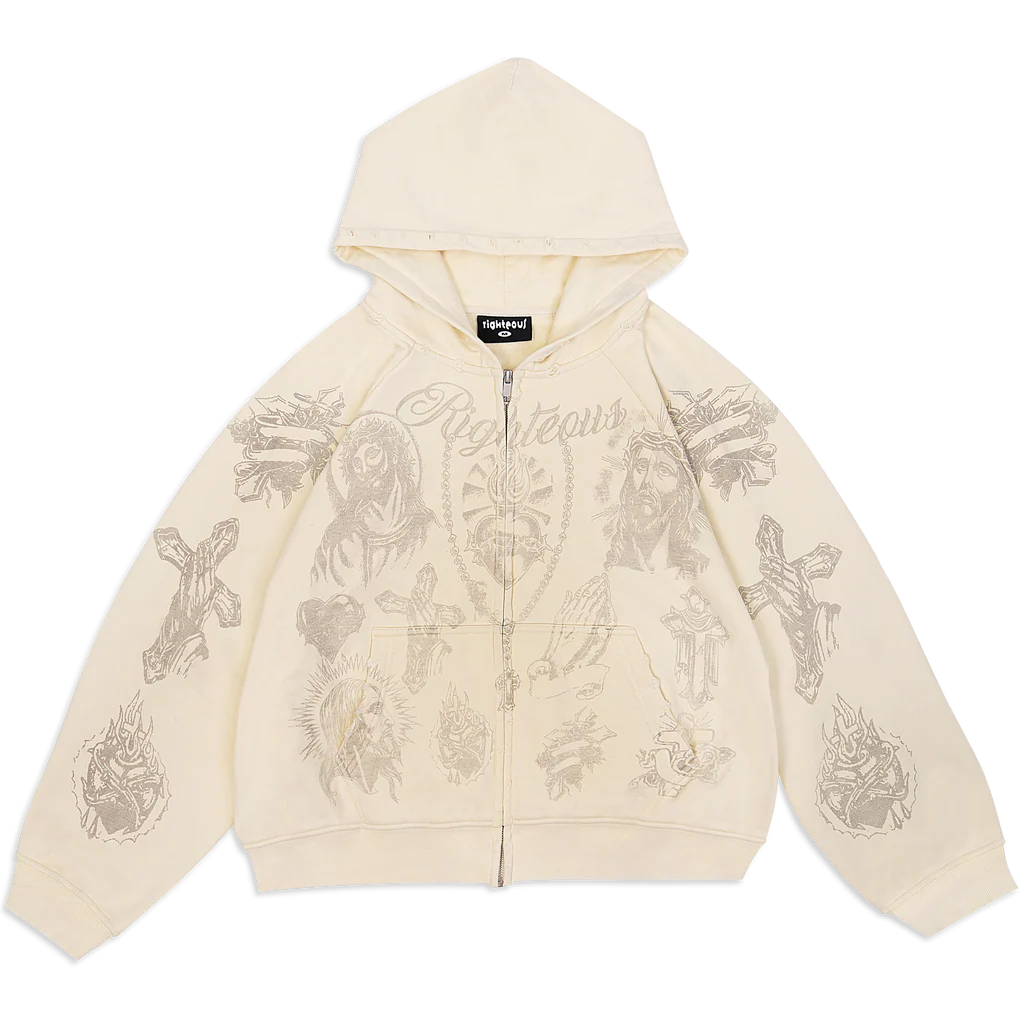

Ultimate Sacrifice Hoodie: The Thermal Set, Explained

Stand still on a cold morning in a regular hoodie and you will learn the difference between a hoodie that looks warm and a hoodie that is warm — in about ninety seconds. The first one photographs fine. The second one is the reason you stop thinking about the weather at all.
That difference has a name, and the name gets thrown around so loosely now that it barely means anything: thermal. This is the piece where we slow down and say exactly what it means — what it does to cold air, why it beats fleece in some moments and loses in others, and how to tell a real one from a label. And then, because a warm top with cold legs is only half a solution, we will show you the set we built around the idea: the Ultimate Sacrifice hoodie, its matching sweats, and the black thermal sweatpants that finish the system.
What “thermal” actually means
Forget the marketing for a second. Warmth is not a fabric. Warmth is still air.
Your body heats the thin layer of air next to your skin. A garment keeps you warm only to the extent that it traps that air and stops the wind from stealing it. Every warm fabric in history is just a different way of building tiny air pockets and holding them still.
Thermal fabric does that job with a tight weave and a brushed or waffle-textured inside. The weave is dense enough that warm air cannot slip straight through it; the brushed interior stands up in thousands of tiny fibres, and each one holds a pocket of air against your skin. It is a quiet, unglamorous mechanism — no loft, no puff, no drama — and that is exactly why it works best in the situation most of us actually live in: standing still, walking slowly, waiting outside, sitting on cold concrete. At rest, thermal holds heat better than almost anything in its weight class.
Here is the part most guides skip, and it matters: thermal is not a thickness. A thin thermal can out-warm a thick loose knit, because the loose knit leaks. What you are feeling for is density and a closed inside surface, not bulk. If you have ever owned a hoodie that felt heavy but left you cold, you have already met the difference.
Thermal vs fleece vs heavyweight cotton
Three fabrics, three different answers to the same question. Most people buy one while needing the other, so here is the honest comparison:
| Fabric | How it warms you | Best moment | Weak spot |
|---|---|---|---|
| Thermal | Tight weave + brushed interior traps still air close to the skin | Standing, walking, waiting — low movement, real cold | Can feel clammy if you sweat hard in it; needs a breather when you move fast |
| Fleece | Brushed polyester loft holds a big volume of air | Moving — hiking, playing, working up a sweat | Wind cuts straight through it without a shell; warmth collapses when the loft is compressed |
| Heavyweight cotton | Dense, heavy knit; warmth from sheer mass | Dry, crisp days; the structured drape streetwear is built on | No wind resistance; cotton holds moisture and goes cold when wet |
Read that table once and the commonest winter mistake becomes obvious. People buy fleece for standing-still cold — the bus stop, the queue, the walk home at midnight — because fleece feels soft in the shop. But softness in the shop is loft, and loft without movement is just air the wind can push around. Fleece wins when you move. Thermal wins when you do not. And most of a winter day is not moving.
That is the first thing worth remembering from this guide: match the fabric to the moment, not to the feeling in the shop.
How to tell if a hoodie is actually thermal: four checks
Labels lie by omission — “thermal” is not a regulated word, so anyone can print it. Your hands are a better test than the tag. Run these four checks before you trust a hoodie with a cold day:
1. Turn it inside out. A real thermal has a brushed, almost suede-like interior, or a visible waffle texture. If the inside looks exactly like the outside — flat, smooth, no nap — it is a regular hoodie with a confident label.
2. Hold it up to the light. Hold the body of the hoodie between your eyes and a lamp. A tight thermal weave lets very little light through. A loose knit glows like a sieve. Light leaking through is warm air leaking out.
3. Feel the drape, not the weight. Pick it up by the shoulders and let it hang. Thermal fabric falls in a clean, close drape — it has body without stiffness. A hoodie that is heavy but floppy is usually just thick, not warm.
4. Blow through the cuff. Put the cuff to your lips and blow. If your breath passes through easily, so will a January wind. A thermal weave pushes back.
Save this list. It takes thirty seconds in a shop and it will save you from ever buying a cold “warm” hoodie again.
Warmth is a system, not a single piece
Here is the second thing worth remembering, and the one that changed how we think about winter pieces: a warm top with cold legs is only half a solution.
Heat does not politely stay where you put it. It rises off your shoulders, it leaves through your legs, it escapes at every gap — the waistband, the ankle, the open zip. A single warm hoodie over thin joggers is like insulating the roof and leaving the windows open. You feel the difference the moment you fix the bottom half: the whole body stops working to stay warm, and suddenly the hoodie you already own feels warmer too.
That is why a thermal set is a different proposition from a thermal hoodie. The zip-up handles the top, the sweats handle the bottom, and together they close the loop. It is not about buying two things instead of one. It is about the fact that warmth, done properly, is a system — and a system has no weak half.
The Ultimate Sacrifice hoodie set, piece by piece
Our thermal range carries one name across all four pieces: Ultimate Sacrifice. If the name sounds like it carries weight, it is supposed to. It is the name we gave to the heaviest, warmest corner of the range — the pieces built for the coldest weeks of the year, carrying the artwork of the crucifixion and the sacred heart. The sacrifice on the cross is the centre of the faith we wear; putting that name on the warmest set we make is our way of saying this is not a seasonal gimmick. It is the serious end of the wardrobe.
The anchor is the Ultimate Sacrifice Thermal Zip Up — $170, in sizes XS to XXL. Full zip, so it works as a mid-layer under a coat and as the outer layer on its own; unzip it two inches and you vent the heat without taking anything off, which is exactly the control a thermal piece needs when you step from cold street into a warm room.
Beside it sits the Sacrifice Thermal Zip Up — also $170, XS to XXL, cut in the same heavyweight, oversized fit our listing describes as soft, heavyweight fabric built for everyday wear. Two zip-ups, one idea: the thermal layer you reach for first, whichever graphic register you prefer.
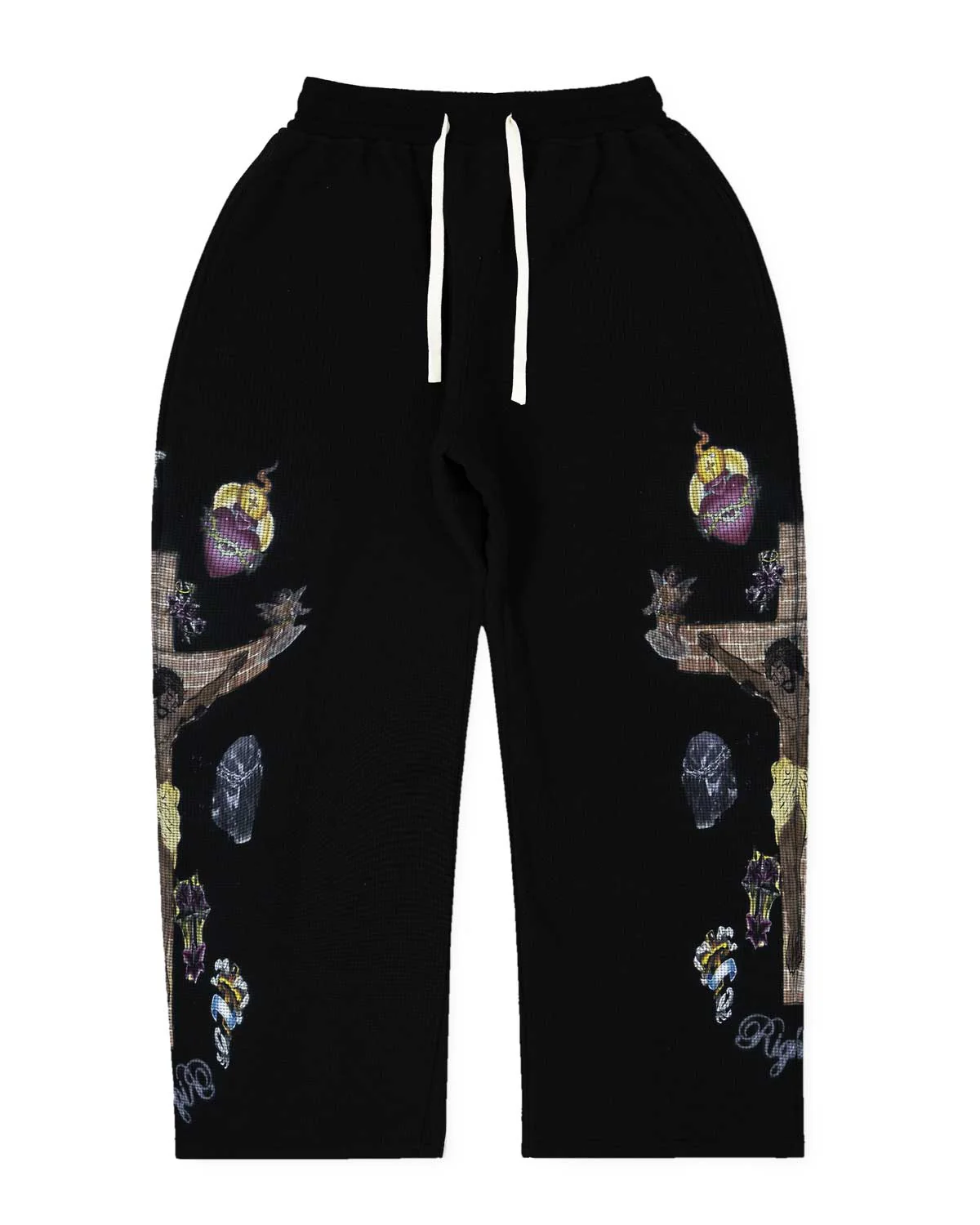
Then the bottom half. The Ultimate Sacrifice Thermal Sweats — $200, XS to XXL — are the matching half of the system: the same thermal build, from waist to ankle, so the loop we described above is actually closed. And the Ultimate Sacrifice Thermal Sweatpants Black — $160, XS to XXL — are the everyday pair in the set: our listing describes them in premium heavyweight thermal cotton fleece, with the crucifixion and sacred heart artwork printed down both legs, the Righteous script near the hem, an elastic waistband with white drawstrings, deep side pockets, and a relaxed oversized cut. Black goes with everything the zip-up goes with, which is the point — a system you can wear as a full set or split across a week.
Four pieces, one idea, no weak half. If you buy one thing from this guide, buy the zip-up. If you buy two, buy the zip-up and the black sweatpants — top and bottom, loop closed, winter handled.
How to wear it: the layering order that actually works
A thermal set is forgiving, but it still rewards a little method. This is the order that works, from skin outward:
Base: a plain tee. Cotton is fine here because the thermal layer above it is doing the insulating. The tee’s job is comfort and sweat management, nothing more. Our Christian streetwear guide explains why the tee underneath is the quiet foundation of the whole look.
Mid: the Ultimate Sacrifice hoodie, our thermal zip-up. Zipped up outside, unzipped a few inches indoors. The zip is the thermostat — use it. A pullover traps you in one temperature; a zip-up lets you choose.
Shell (only when the weather earns it): a windproof layer on top when the wind is real. Remember the table: thermal holds still air beautifully, but it is not a windbreaker. A shell over thermal is the warmest combination in this guide, warmer than either piece alone.
Bottom: the thermal sweats. Same logic as the top — the sweats are the thermal layer for your legs. Under them, nothing special is needed; over them, nothing at all. If the day is brutal, the black sweatpants layer under a pair of baggy denim without a fight, thanks to the relaxed cut.
Fit note: the range is cut oversized — our sizing guide walks through exactly how that drape behaves and whether to size up, down, or stay true. The short version: the oversized cut is the fit, not a mistake; buy your normal size and let the thermal layer sit the way it was drawn. And if you want the styling side — how the set wears with denim, sneakers, and a cap — our oversized hoodie styling guide covers the looks.
How to keep a thermal warm
Warmth is a fabric property, and fabric properties can be destroyed in a washing machine. Three rules, and your thermal stays thermal:
Cold wash, always. Hot water flattens the brushed interior — the tiny fibres that trap air go limp, and once they are flat they cannot trap anything. Cold water keeps the nap standing.
Skip the high-heat dryer. High heat melts and mats synthetic fibres and shrinks cotton fleece. Hang dry, or tumble on the lowest heat you can stand.
No fabric softener. Softener coats fibres in a waxy film. It feels soft and it kills insulation — the film fills the air pockets you are trying to protect. This is the single commonest way people quietly ruin a warm hoodie.
Follow those three and the set you buy this winter is the set you reach for next winter too. For the full wash routine, our guide to hoodie styles, fit and fabric covers what to check before you buy — and before you wash.
FAQ
Is a thermal hoodie warmer than a fleece hoodie?
At rest, yes — thermal’s tight weave and brushed interior hold still air against your body better than fleece loft does, so it wins on cold, still days: waiting, walking, standing around. While you are moving and sweating, fleece breathes and dries faster, so it wins there. Most winter days are mostly still, which is why thermal is the better default.
Is “thermal” the same as waterproof?
No. Thermal describes insulation, not water resistance. A thermal hoodie will keep you warm in the cold, but it will still get wet in rain — and wet cotton fleece goes cold fast. In wet weather, wear a waterproof shell over the thermal layer.
What should you wear under a thermal hoodie?
A plain tee is enough. The thermal layer does the insulating; the tee underneath is for comfort. If it is truly freezing, a thin base layer under the tee adds warmth without bulk. The zip-up’s venting does the rest.
Do thermal sweatpants actually help, or is the hoodie enough?
They help more than people expect. Heat escapes through your legs just as it does through your torso, and a warm top over cold legs leaves the system half open. Matching thermal bottoms close the loop — the whole body stops working to stay warm, and the hoodie feels warmer as a result.
What does “Ultimate Sacrifice” mean?
It is our name for the heaviest, warmest set in the range, and it refers to the sacrifice of Christ on the cross — the artwork on the pieces carries the crucifixion and sacred heart imagery. The name is a statement of what the set is for: the serious, coldest end of the wardrobe, worn with the story at the centre of our faith.
Cold weather is not a reason to hide your faith under a shapeless coat. It is the season when what you wear has to work hardest — and the pieces that work hardest are the ones worth naming. The thermal zip-up starts the system; the sweats finish it. The rest is just winter, handled. Explore the full set in our righteous hoodies collection, and check your fit against our sizing guide before you order.